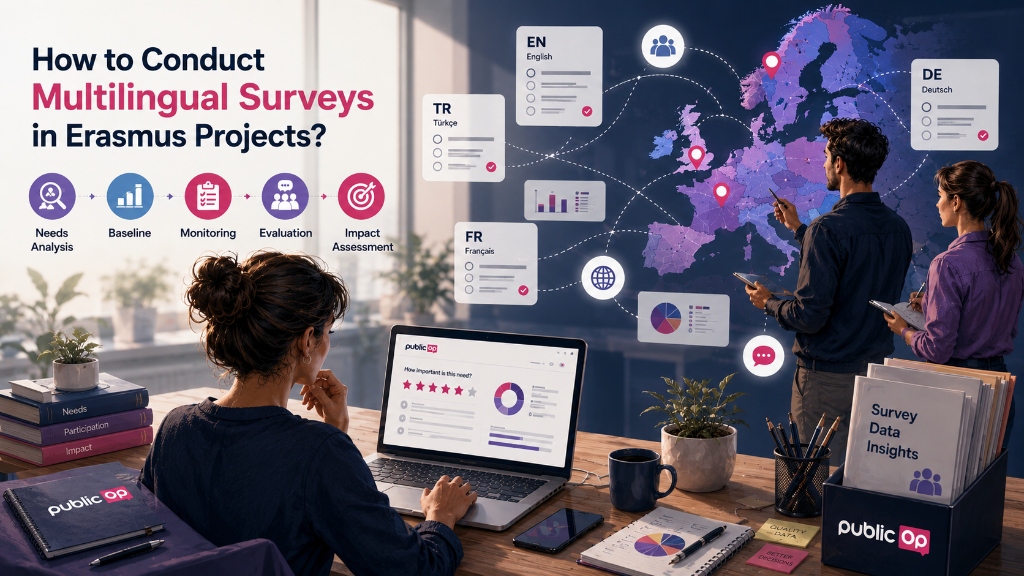
Multilingual surveys are one of the simplest ways to make an Erasmus+ project more evidence-based. They can help applicants validate a project idea before submission, compare needs across partner countries, collect participant feedback during implementation, test project outputs and produce stronger evidence for dissemination, exploitation of results and impact reporting.
In many Erasmus+ projects, however, surveys are treated as a minor administrative task. A form is created, translated quickly, circulated through partner networks and later summarised in a few charts. That approach may be enough for basic feedback, but it often fails to support serious project design, evaluation or reporting.
A strong multilingual survey is not just a translated questionnaire. It is a research instrument designed to collect comparable data across languages, countries and target groups.
Why multilingual surveys matter in Erasmus+ projects
Erasmus+ projects often involve international partnerships, cross-border learning activities and target groups that speak different languages. A single-language survey can limit participation, distort feedback and make some groups less visible in the project evidence.
Multilingual surveys help project teams answer practical questions such as:
- Is the project idea based on a real need?
- Do target groups in different countries experience the problem in the same way?
- Which needs are most urgent for each participant group?
- Are project activities producing useful learning outcomes?
- Are the outputs understandable, usable and relevant?
- Which dissemination channels are reaching the right audiences?
- What evidence can be used in the final report and sustainability plan?
For Erasmus+ projects, this matters because quality is not only about delivering activities. It is also about showing that the project responds to real needs, involves the right target groups, produces relevant results and creates value beyond the project partnership.
What is a multilingual survey in an Erasmus+ context?
A multilingual survey is a survey that allows participants to answer in different languages while preserving a common research structure.
This means that language versions should not become separate, inconsistent forms. They should be connected to the same questionnaire logic, the same indicators and the same analytical framework.
A well-designed Erasmus+ multilingual survey should ensure that:
- each language version asks the same question in equivalent meaning,
- response options remain comparable across countries,
- data can be analysed in one dataset,
- results can be filtered by country, language or target group,
- open-ended responses can still be interpreted in context,
- findings can be used in project applications, reports and dissemination materials.
The goal is not only linguistic accessibility. The goal is comparable evidence.
When should Erasmus+ projects use multilingual surveys?
Multilingual surveys can be useful at several points in the Erasmus+ project lifecycle. The key is to match the survey type to the project stage.
| Project stage | Survey type | Main purpose |
|---|---|---|
| Before application | Needs validation survey | Test whether the project idea responds to a real need |
| Project start | Baseline survey | Measure the starting point before activities begin |
| During implementation | Monitoring and feedback survey | Track quality, satisfaction and early outcomes |
| After training or mobility | Participant evaluation survey | Measure learning experience and perceived gains |
| Pilot phase | Output testing survey | Assess whether tools, guides or modules are usable |
| End of project | Impact and evaluation survey | Collect evidence for results, impact and reporting |
| After dissemination | Stakeholder feedback survey | Understand reach, relevance and potential exploitation |
This structure prevents a common problem: asking too many questions at the wrong time. A pre-application survey should usually be short. A final evaluation survey can be more detailed. A pilot output survey should focus on usability and relevance, not on every aspect of the project.
How multilingual surveys strengthen Erasmus+ needs assessment
A weak needs assessment often relies on broad claims: “teachers need digital skills”, “young people need inclusion opportunities”, “NGOs need better tools” or “adult learners need more support”. These statements may be true, but they are not strong enough on their own.
A short multilingual survey can turn a general assumption into project-specific evidence.
Before application, a survey can help identify:
- how strongly the target group recognises the problem,
- whether the same need exists across partner countries,
- which target groups are most affected,
- which barriers are most common,
- which project outputs would be most useful,
- whether stakeholders would participate in pilots or activities.
This evidence can support several sections of an Erasmus+ proposal:
- needs analysis,
- project rationale,
- target group definition,
- project objectives,
- work package design,
- expected results,
- dissemination strategy,
- sustainability planning.
Instead of saying that a need exists, the applicant can show that the need has been tested with the relevant audience.
How long should an Erasmus+ survey be?
The right survey length depends on the project stage and the decision the survey is meant to support.
A pre-application needs validation survey should usually be short. If the goal is to test the relevance of a project idea, 3 to 7 focused questions may be enough. The aim is not to produce an academic study. The aim is to collect credible early evidence from the target group.
A baseline or final evaluation survey can be longer because it supports deeper measurement. But even then, every question should have a clear purpose.
A useful rule is simple: do not ask a question unless you know how the answer will be used.
How to design a pre-application Erasmus+ survey
A pre-application multilingual survey should be short, mobile-friendly and easy to complete. It should help the applicant understand whether the project idea has real relevance for the target group.
A practical structure includes four parts.
1. Target group profile
First, identify the participant’s role or profile. This helps you compare needs across groups.
Possible profile categories include:
- teacher,
- student,
- youth worker,
- NGO professional,
- trainer,
- adult educator,
- school leader,
- volunteer,
- researcher,
- policymaker,
- parent or caregiver.
Avoid collecting unnecessary personal data. For many needs assessment surveys, role, country, organisation type and target group may be enough.
2. Current challenge
Ask participants what problem they currently face. Use clear options and allow one “other” field if needed.
Example question:
What is the main challenge you currently face in this area?
Possible answers:
- lack of training materials,
- limited digital tools,
- weak cooperation between organisations,
- difficulty reaching the target group,
- low awareness,
- lack of resources in the local language,
- limited staff capacity,
- other.
This creates data that can be used directly in the needs analysis section of a proposal.
3. Priority need
The next step is to identify what kind of support would be most useful.
Example question:
Which type of support would be most useful for your work?
Possible answers:
- training module,
- online tool,
- practical guide,
- workshop,
- good practice examples,
- multilingual resources,
- assessment toolkit,
- cooperation model.
This helps connect project outputs to actual demand.
4. Interest in the project idea
Finally, test whether the target group would use or engage with the proposed solution.
Example question:
How likely would you be to use this resource or participate in a pilot activity?
This type of question does more than measure need. It also measures potential engagement, which can strengthen the project’s relevance and implementation logic.
How to avoid translation problems in multilingual surveys
Translation is one of the biggest risks in multilingual survey design. Two questions may look equivalent but create different meanings in different languages. If that happens, the data becomes harder to compare.
Start with a clean source questionnaire
The source version should be simple, precise and free from unnecessary jargon. Long sentences, idioms and culturally specific expressions should be avoided.
Weak question:
How would you assess your institution’s multi-stakeholder digital transformation capacity in relation to inclusive learning outcomes?
Better question:
How effectively does your organisation use digital tools in education, training or youth work?
A clear source questionnaire makes every translation better.
Build a shared terminology list
Erasmus+ projects often use terms that are familiar to project managers but not always clear to participants.
Define key terms before translation, such as:
- needs assessment,
- target group,
- work package,
- deliverable,
- result,
- impact,
- dissemination,
- exploitation of results,
- baseline,
- evaluation,
- learning outcome,
- inclusion,
- sustainability.
This is especially important when the survey will be used by several partner organisations.
Ask local partners to review meaning, not just grammar
A translation can be grammatically correct and still fail with the target audience. Local partners should check whether the wording is natural, understandable and appropriate for the group being surveyed.
For example, “exploitation of results” is a standard Erasmus+ term, but a literal translation may sound strange or even misleading in some languages. In a participant-facing survey, it may be clearer to ask whether people plan to use, share or adapt the project results.
Keep scale logic consistent
Likert scales, frequency scales and satisfaction scales must remain consistent across languages.
Be careful with:
- strongly agree / agree / neutral / disagree / strongly disagree,
- very useful / useful / slightly useful / not useful,
- often / sometimes / rarely / never,
- very high / high / medium / low / very low.
If scale wording shifts between languages, comparisons become unreliable.
Pilot each language version
Before launching the survey, test each language version with a small number of people from the target group. Ask them whether any question is confusing, too technical or open to different interpretations.
Even 3 to 5 pilot responses per language can reveal major problems before the survey is widely distributed.
How to use survey data in an Erasmus+ application
Survey data should not be copied into the application as raw tables. It should be translated into a clear project argument.
In the needs analysis
Use the data to show that the target group recognises the problem and that the project responds to a defined need.
Example wording:
A short multilingual needs survey conducted across partner countries showed that teachers and youth workers identified practical, local-language materials as one of the most urgent needs in this field.
If you use percentages, make sure they come from actual data. Do not present assumptions, partner opinions or informal discussions as survey findings.
In the project objectives
Each objective can be linked to a need found in the survey.
For example, if respondents identify a lack of practical tools, one project objective can focus on developing, testing and disseminating a practical toolkit.
In work package design
Survey findings can explain why a work package is necessary.
For example:
- Work Package 1: needs assessment and methodology,
- Work Package 2: content and tool development,
- Work Package 3: pilot implementation,
- Work Package 4: evaluation and impact measurement,
- Work Package 5: dissemination and exploitation of results.
This shows that the project structure is not arbitrary. It is connected to evidence.
In impact planning
A pre-project survey can also create a baseline for later comparison. If the same or similar questions are asked at the end of the project, the team can show change over time.
This is especially useful for measuring:
- knowledge gains,
- confidence,
- readiness to use project outputs,
- institutional capacity,
- cooperation between partners,
- perceived usefulness of project resources.
Baseline, results, deliverables and impact: what should surveys measure?
Erasmus+ project teams often mix up baseline, results, deliverables and impact. Surveys become more useful when these concepts are separated clearly.
Baseline
Baseline refers to the starting point before the project intervention. It can measure participants’ current knowledge, confidence, practices, institutional capacity or access to resources.
Example baseline questions:
- How would you rate your current knowledge of this topic?
- Has your organisation used similar tools before?
- What support do you currently lack?
- How confident are you in applying this approach?
Results
Results refer to changes produced during or after the project. These may include changes in knowledge, skills, attitudes, awareness or intention to act.
Example result questions:
- Did the training improve your understanding of the topic?
- Are you more confident using this method?
- Do you plan to use the project materials in your work?
- Did the activity help you develop new skills?
Deliverables
Deliverables are the tangible outputs produced by the project: guides, toolkits, training modules, reports, platforms, videos, methodologies or open educational resources.
Surveys can assess whether these outputs are useful.
Example deliverable evaluation questions:
- Is the guide easy to understand?
- Is the toolkit practical for your work?
- Is the training module relevant to the target group?
- Can the resource be adapted to your local context?
Impact
Impact refers to broader effects beyond immediate satisfaction or output delivery. It can be individual, organisational or community-level.
Example impact questions:
- Has the project helped your organisation adopt a new practice?
- Are you likely to continue using the project results?
- Has cooperation between partner organisations improved?
- Can the project outputs be used by other institutions?
Impact claims should be careful and proportionate. A short project may not prove broad social change, but it can provide credible indicators of learning, adoption, capacity and future use.
How surveys support dissemination and exploitation of results
Dissemination is not only about visibility. It is about making project results known to the right audiences. Exploitation of results is about encouraging those results to be used, adapted or sustained after the project.
Multilingual surveys can support this by showing:
- which outputs were most useful for each target group,
- which countries or audiences showed the strongest interest,
- which dissemination channels worked best,
- whether stakeholders intend to use the project results,
- what formats are preferred by the audience,
- what improvements are needed before wider dissemination.
This evidence can be used in:
- final reports,
- impact reports,
- project websites,
- social media summaries,
- stakeholder presentations,
- sustainability plans,
- future funding applications.
A strong survey does not only ask whether participants liked an activity. It asks whether the project results can be used beyond the activity.
Why survey distribution needs its own plan
Creating a survey is not the same as reaching the right respondents. Many Erasmus+ surveys are distributed only through partner mailing lists and immediate institutional networks. This may be practical, but it can limit the diversity and credibility of the data.
A distribution plan should define:
- who the target respondents are,
- which countries or languages are included,
- which partner is responsible for each audience,
- how many responses are realistic,
- which channels will be used,
- how the sample limitations will be described.
Possible distribution channels include:
- partner organisation mailing lists,
- schools, universities and NGOs,
- professional associations,
- LinkedIn groups,
- Facebook communities,
- WhatsApp and Telegram groups,
- event registration lists,
- project websites,
- targeted social media campaigns.
Targeted digital outreach can be useful when a project needs to reach beyond existing partner networks. But the method must be described honestly. Paid social media distribution is not random sampling, and it should not be presented as such.
Why mobile-friendly surveys matter
Many Erasmus+ participants open survey links on their phones. This is especially true for young people, volunteers, event participants, field workers and busy educators.
A mobile-friendly survey should:
- use short questions,
- avoid large matrix grids,
- keep answer options easy to tap,
- limit open-ended questions,
- reduce unnecessary page switching,
- show progress where useful,
- avoid long introductory text.
Mobile usability is not just a design issue. It affects completion rates, data quality and participant inclusion.
Where PublicOp fits into the Erasmus+ survey workflow
PublicOp can support Erasmus+ project teams that need to create, publish and analyse multilingual surveys in a structured way. It is especially useful when a project needs more than a basic one-off form.
For example, a project team can use PublicOp to:
- create short needs validation surveys,
- publish surveys in multiple languages,
- collect responses into one comparable dataset,
- monitor live reports during distribution,
- compare responses by language, country or target group,
- collect participant feedback after activities,
- evaluate project outputs,
- export data for reporting or further analysis.
In this context, PublicOp functions as a research operations platform rather than only a survey form builder. It helps teams connect survey design, multilingual data collection, reporting and evidence-based decision-making across the project lifecycle.
Data protection and ethical considerations
Erasmus+ survey design should also consider data protection and ethics. Project teams should collect only the data they need and explain clearly how responses will be used.
Key principles include:
- collect only necessary data,
- explain the purpose of the survey,
- avoid unnecessary personal identifiers,
- clarify whether responses are anonymous or confidential,
- describe how data will be used and stored,
- be careful with sensitive data,
- apply additional safeguards for children or vulnerable groups,
- avoid publishing identifiable responses in reports.
In multi-country projects, partners should also agree on who can access the data, where it is stored, how long it will be retained and how results will be anonymised before publication.
Practical checklist for Erasmus+ multilingual surveys
Before launching a multilingual survey, review the following questions:
- Is the purpose of the survey clear?
- Is it linked to a specific project stage?
- Is the target group well defined?
- Are the questions short and understandable?
- Will every question be used in analysis?
- Do all language versions preserve the same meaning?
- Are response options comparable across languages?
- Is the survey easy to complete on mobile?
- Are open-ended questions limited and purposeful?
- Is the data protection notice clear?
- Is there a realistic distribution plan?
- Can the methodology be explained honestly in the report?
- Will the findings support application, evaluation, dissemination or impact reporting?
This checklist helps ensure that the survey is not just a form, but a useful evidence tool for the project.
Conclusion
Multilingual surveys can significantly improve the quality of Erasmus+ project design, implementation and reporting. They help project teams validate needs, compare partner-country perspectives, collect structured feedback, test outputs and produce stronger evidence for impact and dissemination.
The strongest surveys are short when they need to be short, detailed when they need to support evaluation, and always consistent across languages. They avoid unnecessary personal data, preserve comparable response structures and connect directly to project decisions.
For Erasmus+ teams, the real value of a multilingual survey is not the form itself. It is the evidence it creates for better project design, better implementation and more credible reporting.